Wednesday, March 11, 2009

Pakistan arrests opposition leaders ahead of planned rallies
Pakistan arrests opposition leaders ahead of planned rallies

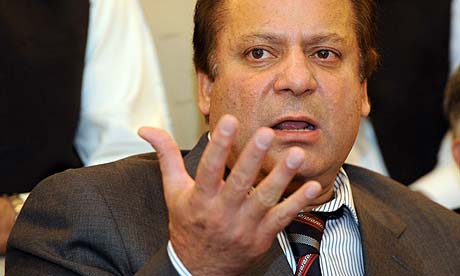
Nawaz Sharif addresses a press conference in Islamabad

Nawaz Sharif is the head of the Pakistan Muslim League N party. Photograph: Farooq Naeem/AFP/Getty images

The crisis engulfing Pakistan deepened this morning after the government issued orders for opposition leaders, including Imran Khan and Nawaz Sharif, to be placed under house arrest ahead of planned rallies against the ruling administration.

Police have arrested scores of lawyers and opposition leaders today and, according to reports on Pakistani television, orders have been issued for the detention of Sharif, the head of the Pakistan Muslim League N party (PML-N), his brother Shabhaz Sharif, the Jamat-e-Islami leader, Qazi Hussain Ahmed, and Khan, who is the head of Tehreek-e-Insaf.

Many opposition leaders are said to have gone into hiding. Pakistani lawyers, supported by opposition leaders, are due to begin a protest tomorrow dubbed the long march to demand the restoration of judges removed from office by the former president Pervez Musharraf.

President Asif Ali Zardari, husband of the assassinated former prime minister Benazir Bhutto, has failed to fulfil a pledge to restore the justices since being elected last year.

The clampdown will increase fears for the stability of the country as the government struggles to contain violent extremists.

Six Pakistani policemen and a bus driver were killed, and six Sri Lankan cricket players and two team officials wounded last week when heavily armed men attacked a bus carrying the visiting team to the venue of the second test against Pakistan.

Rao Iftikhar, the home secretary in eastern Punjab province, said he issued orders for a ban on public gatherings there "so that terrorists cannot take any advantage by targeting political gatherings".

The ban , which gives authorities the right to arrest any protesters, will remain in force for three months, he said.

Punjab is Pakistan's most powerful and populous province and the political stronghold of the PML-N.

Last week's attack on the Sri Lankan cricket team came amid protests following a court ruling banning the former minister Sharif and his brother, who was the chief minister of Punjab, from political office.

In August last year Sharif pulled his party out of a coalition with Zardari's Pakistan People's party (PPP), because of the failure to restore the judiciary. His supporters saw the latest court ruling as a political move engineered by Zardari.

The planned long march would see protesters gather in cities around the country tomorrow before leaving for the capital, Islamabad. They have vowed to stage a sit-in at the parliament building until the judiciary is restored.

The Sindh province home secretary, Arif Ahmed Khan, announced a 15-day ban on public gatherings today to "prevent a bad law-and-order situation". Sindh is the main stronghold of the ruling PPP.

A spokesman for Sharif's party, Sadiqul Farooq, said he received reports from party offices across the country that members were being arrested, but he had no accurate numbers.

Munawar Hassan, a Jamaat-e-Islami leader, said: "Nearly two dozen of our supporters have been detained."

Farhatullah Babar, a spokesman for Zardari, said 18 people had been arrested and would be released once the situation calmed down.

"Some people have announced they are going to defy the ban on public meetings," he said. "It is sad, but this is what the law says."

In the Punjabi city of Multan, the senior police officer Fayyaz Ahmad said 42 Sharif supporters were arrested and "would be dealt with according to the law".

Obama to lay out guidelines to overhaul earmarks

Obama to lay out guidelines to overhaul earmarks

(CNN) -- President Obama on Wednesday will talk about new guidelines aimed at cutting down the number of earmarks in appropriations legislation, one day after the Senate passed a spending bill with nearly 9,000 earmarks, his administration said.

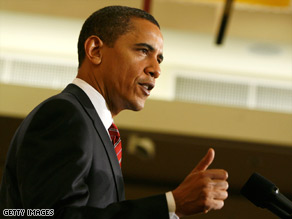
President Obama on Wednesday will announce new "rules of the road" on earmarks, the White House says.

President Obama on Wednesday will announce new "rules of the road" on earmarks, the White House says.

Earmarks are unrelated pet projects that members of Congress insert in spending bills.

Some lawmakers have urged Obama to veto the $410 billion omnibus spending bill -- saying it goes against the president's campaign pledge to bring an end to wasteful spending.

White House officials said Obama will sign the bill to keep key government agencies funded, but the president will lay out the new guidelines on earmarks as a not-so-subtle threat that he could veto future spending bills that do not comply with his objectives.

Obama may sign the bill into law behind closed doors rather than make a public show of it, White House press secretary Robert Gibbs said.

"Although it's not perfect, the president will sign the legislation but demonstrate for all involved rules moving forward that he thinks can make this process work a little bit better," Gibbs said at his daily briefing with reporters.

White House officials have tried to dismiss the pork-laden legislation as "last year's business" that Obama is dealing with reluctantly.

Gibbs added that "over the course of the president's tenure in Washington, dozens of those bills will come to his desk" and Obama wants to make clear "that there will be some new rules of the road" for lawmakers to follow.

Top Democrats, including House Majority Leader Steny Hoyer of Maryland, have suggested lawmakers do not appreciate being dictated to on an issue that is a congressional prerogative.

Asked last week about the administration's plan to put forth guidelines to overhaul earmarks, Hoyer said flatly, "I don't think the White House has the ability to tell us what to do."

He paused and quipped to reporters, "I hope you all got that down."

Given the sensitivity of the issue with fellow Democrats, senior White House aides were reluctant Tuesday evening to preview any of the new "rules of the road" the president will lay out. Obama's schedule for Wednesday includes a public announcement on "earmark reform" in the morning.

Obama's budget director made a vow Sunday that the president will bring a halt to pork-laden bills.

"[Such bills] will not happen when the president has the full legislative and appropriations process in place," Peter Orszag, director of the White House Office of Management and Budget, told CNN's "State of the Union With John King."

He argued that the White House had little choice but to support the omnibus spending bill, which it inherited from the previous administration.

"This is like your relief pitcher coming into the ninth inning and wanting to redo the whole game," Orszag said. "Next year we're going to be the starting pitcher, and the game's going to be completely different."

But House Minority Whip Eric Cantor, R-Virginia, rejected this argument, noting that Obama had vowed to take action against earmarks during the presidential campaign.

"If you make a promise, people expect that you live up to it. And that's why this administration's refusal to go in and change this bill, I think, is a false position," Cantor told "State of the Union."

"There is no way anyone could take what Mr. Orszag has said with any credibility."

Students killed in German

Students killed in German school shooting


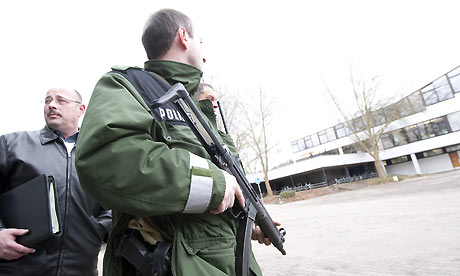
Policemen in front of the crime scene at the Albertville-School Centre in Winnenden

Policemen in front of the crime scene at the Albertville-School Centre in Winnenden near Stuttgart, Germany Photograph: Sascha Baumann/Getty Images

A gunman dressed in a black combat uniform opened fire at a high school in southern Germany this morning, killing at least 15 people and injuring others before he was shot and killed by police.

The Deutsche Press-Agentur news agency said the killer was a 17-year-old former pupil from Albertville school in the Stuttgart suburb of Winnenden.

The Bild newspaper reported that the gunman was shot by police marksmen in a shopping centre in nearby Wendlingen.

He killed nine students and three teachers at the school, as well as one person at a nearby clinic.

In a shoot-out with police, two additional passers-by were killed and two police seriously injured, bringing the total death toll to 16 including the gunman, a police spokesman told Reuters.

"He went into the school with a weapon and carried out a bloodbath," said the regional police chief, Erwin Hetger. "I've never seen anything like this in my life."

The gunman entered the school at 9.30am (8.30am GMT) and opened fire at random before fleeing, police said. The school was then evacuated.

Police could not confirm media reports that the gunman was a former student at Albertville, but Germany's Bild newspaper said the 17-year-old had left the school two years ago. The paper reported that his parents had 18 weapons in their house. Armed police stormed the home and took his mother in for questioning, the paper said. The boy's father was a "wealthy businessman" from a neighbouring area, it said.


View large map

About 1,000 children attend the school in a suburb 12 miles (20km) north-east of Stuttgart.

"We have to anticipate a death toll in double digits," said a spokeswoman for the Stuttgart authorities.

German television said the gunman fled towards the centre of Winnenden. Reuters reported that helicopters circled above the town while rescue workers and firefighters were at the school. Witnesses told German media of hearing shots and screaming. One pupil said she first thought it was a joke, then saw her classmates jump out of windows before fleeing herself.

A police spokesperson told Bild the gunman shot a passerby near the psychiatric clinic in Winnenden. A worker from the clinic told the paper: "I heard six or seven shots. I am not allowed to leave my post."

Several school shootings have shocked Germany in recent years. In 2006, a masked man wearing explosives and brandishing rifles opened fire at a school in the western German town of Emsdetten, wounding at least 11 people before killing himself.

In April 2002, Germany saw its worst school shooting when a gunman killed 16 people, before turning the gun on himself, at a high school in the eastern city of Erfurt.

source:www.guardian.co.uk

Wednesday, January 7, 2009

Israel launches fresh strikes on Gaza

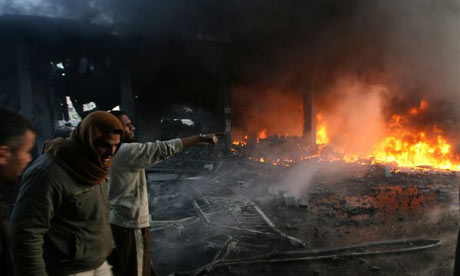
Palestinian men look on as flames rise from debris at the site of an Israeli air strike in Rafah, Gaza

Palestinian men look on as flames rise from debris at the site of an Israeli air strike in Rafah, Gaza

Israel launched a fresh wave of air strikes on the Hamas-ruled Gaza Strip today, as one of the deadliest assaults on Palestinian militants continued for a second day.

Palestinian officials said 280 people had been killed and more than 600 wounded since Israel's campaign to stop rocket barrages from Gaza began at midday yesterday.

Israeli military spokesman Avi Benayahu said some 250 attacks had been carried out since the offensive began and infantry and armoured units were already heading to the Gaza border for a possible ground invasion.

Witnesses said the latest attacks struck one of Hamas's main security compounds in Gaza City, a mosque, the Hamas-run Al Aqsa television station, a prison and dozens of other targets.

Israel's prime minister, Ehud Olmert, said the campaign could last longer than initially anticipated, and the Israeli cabinet approved the call-up of thousands of reservists at its weekly meeting today.

Olmert warned that the offensive against Gaza militants was "liable to take longer than we can foresee at this moment" and said the operation was intended to restore tranquility to Israel's south, where lives have been disrupted by militant rocket and mortar attacks.

The streets were empty in Gaza City today as most residents stayed home, fearing more air strikes. A few lined up to buy bread outside two bakeries. Schools were shut for the three-day mourning period the Gaza government declared for the campaign's dead. Hamas police kept a low profile, wearing jackets over their dark blue uniforms and walking close to walls, hoping to evade the detection.

Meanwhile, the militants kept up the pressure on Israel, firing dozens more rockets and mortars at Israeli border communities early today. One rocket struck close to the largest city in southern Israel, Ashdod, 23 miles from Gaza. It reached almost twice as deep into Israeli territory as ever before and confirmed security officials' concerns that militants are capable of putting major cities within rocket range.

In New York, the United Nations security council expressed serious concern about the escalating situation in Gaza and called on Israel and the Palestinians to immediately halt all violence and military activities. The UN's most powerful body called for a new ceasefire between Israel and Hamas, and for the opening of border crossings into Gaza to enable humanitarian supplies to reach the territory.

The Palestinian president, Mahmoud Abbas, called on his rivals in Hamas to renew a truce with Israel to avoid further bloodshed in Gaza. Speaking after a meeting with the Egyptian president, Hosni Mubarak, Abbas appealed to leaders in the militant Hamas group "to stop the bloodshed".

Many of Israel's western allies have also urged restraint on both sides, although the US blamed Hamas for the fighting.

As world leaders called for an immediate end to the biggest air assault on Gaza since 1967, Ehud Barak, the Israeli defence minister, refused yesterday to rule out a ground invasion in the next few days, saying that the retaliation against Hamas rocket attacks had only just begun. "It won't be easy and it won't be short," said Barak. "There is a time for calm and a time for fighting, and now the time has come to fight."

Asked if a ground invasion would be the next move, as bomb attacks continued into the night, Barak said: "I do not exclude anything as long as the result has not been achieved."

Yesterday a flight of Israeli F-16 fighters fired at least 30 missiles in strikes against Hamas positions in Gaza.

Gordon Brown last night expressed "deep concern" and urged both sides to exercise restraint, amid signs that tit-for-tat clashes were spiralling out of control. He said the only way to reach a lasting solution was through peaceful means. "I understand the Israeli government's sense of obligation to its population. Israel needs to meet its humanitarian obligations, act in a way to further the long-term vision of a two-state solution, and do everything in its power to avoid civilian casualties," he said.

A White House spokesman said the United States "urges Israel to avoid civilian casualties as it targets Hamas in Gaza", adding: "Hamas's continued rocket attacks into Israel must cease if the violence is to stop."

Hamas remained defiant. "Today we are stronger then we've ever been," said its spokesman Taher Nounou. "We won't raise the white flag, we won't give anything up, we won't retreat. We call on the Arab states in the region to take a stance against this massacre and not to be satisfied with just condemnations." Fawzi Barhoum, another spokesman, called the air strikes a "holocaust" and "an act of war".

The attacks, which came days after a ceasefire expired, prompted speculation that Israel might be preparing a full-scale military invasion of Gaza. Ehud Olmert, Israel's prime minister, said: "Israel wishes to make clear that it will continue to act against terrorist operations and missile fire from the strip which is intended to harm civilians." Public support for an attack has been growing in Israel, where a recent opinion poll showed that 20% of voters supported reoccupying Gaza, 27% wanted a return to assassinations and 18% wanted a short military strike.

The Arab League is convening an emergency meeting on Wednesday. Egypt announced it would open its border with Gaza to allow the injured to be treated.